
DuraFlex Chimney Sweep in Almaden: A Homeowner’s Guide
A stainless steel liner and a DuraFlex liner are not interchangeable products quoted at different price points. They solve structurally different problems, and confusing the two is how Almaden homeowners either overpay for a reline they don’t need or under-fix a flue that’s actively failing. DuraFlex is a flexible stainless steel relining system built for specific conditions: off-vertical flue runs, clay tile liners with cracked or spalled joints, and appliances that need a correctly sized vent path without major masonry demolition. It’s a purpose-built fix, not a universal upgrade.
If you’re in Almaden and want a straight answer about whether your chimney actually needs a DuraFlex liner, the fastest path is a camera inspection. We’ll look at the flue with you and show you what the scope sees. Call (833) 593-6691 and we’ll schedule it. But if you’d rather understand the decision before anyone steps on your roof, here’s the guide we wish every homeowner read first.
What DuraFlex Is Actually Engineered To Do
DuraFlex is a convoluted stainless steel liner, made from a specific alloy blend that’s rated for gas, oil, and wood-burning appliances depending on the liner grade. The word “flexible” is the point. Unlike rigid stainless sections that get welded or screwed together in straight runs, DuraFlex bends through offset smoke chambers and around the kinds of structural obstructions that older Almaden custom homes are full of.
We’ve pulled liners through chimneys in the Country Club area and over in the hills behind Almaden Lake where the flue doesn’t run straight up. A rigid liner in those situations means cutting into masonry to straighten the path, which is expensive and invasive. DuraFlex snakes through the existing clay tile path, and because it’s designed as an engineered system rather than a patch, the connection points and terminations come from the same manufacturer. That’s why it’s part of what we source from Chimney Sweep Almaden home material suppliers like Olympia Chimney and Copperfield.
In our experience, the confusion usually starts when a homeowner gets two quotes: one for a rigid liner, one for DuraFlex. The rigid quote is lower. The DuraFlex quote is higher. The homeowner assumes the flexible option is the premium version of the same thing. It’s not. DuraFlex is the solution for a flue geometry problem. If your chimney is a straight shot, rigid liner works fine. If it’s offset, curved, or constrained by original framing, DuraFlex is often the difference between a clean reline and a masonry demolition job.
When DuraFlex Makes Sense in Almaden (And When It Doesn’t)
This is the section where most guides get vague. Let’s be specific about conditions we see in Almaden’s housing stock.
DuraFlex is typically the right call when:
- The existing clay tile liner is cracked, spalled, or has missing mortar joints, and the chimney structure itself is still sound.
- The flue path is offset or non-vertical, common in homes built in the 1960s through 1980s around the Almaden Valley foothills.
- You’re switching fuel types. Going from an old open-hearth wood burner to a gas insert almost always requires a correctly sized liner, and the flexible system adapts to the existing dimensions without rebuilding.
- The appliance you’re venting has specific draft requirements that the oversized original clay flue can’t meet. A wood stove on a 13×13 clay tile flue drafts poorly. A properly sized DuraFlex liner fixes that.
DuraFlex is typically not the right call when:
- The masonry itself is failing. A liner doesn’t stabilize a crumbling chimney crown or shifting brickwork. That’s a structural repair.
- The existing flue is already in good shape and the only issue is creosote buildup. That’s a sweep, not a reline.
- The chimney serves an open fireplace with no appliance change planned and the clay liner has minor surface wear but no structural compromise. Resurfacing with products like HeatShield can be the less invasive option.
The point: a contractor who recommends DuraFlex without first putting a camera up the flue is guessing. A contractor who recommends it after showing you footage of cracked joints and explaining why your offset flue can’t take rigid liner is doing the job right. The recommendation should follow the evidence, not the other way around.
How to Read a Liner Quote Without Getting Burned
Liner quotes are where honest contractors and lazy ones separate themselves, and Almaden homeowners should know exactly what a complete DuraFlex installation includes. Here’s what we include on every reline quote we write, and what you should demand from anyone else’s:
A complete DuraFlex quote should include:
- Camera inspection before and after. You need footage of the existing flue condition to justify the reline, and footage after installation to prove it was done correctly. If a quote doesn’t include a post-installation camera scan, walk away.
- The liner, properly sized. Diameter matters. Too big and the appliance won’t draft. Too small and you’re creating a restriction. The quote should state the diameter and why it matches your appliance.
- Top plate and rain cap. The liner terminates at the top of the chimney with a top plate that seals the flue opening and a cap that keeps water and animals out. These are not “extras.” They’re part of the system.
- Connection hardware at the appliance. This is the part that gets left off most often. The connection between the flexible liner and the appliance collar, usually through a tee or a boot, is where leaks and failures happen. A complete quote specifies this hardware.
- Insulation, if required. For wood-burning appliances, the liner often needs insulation wrap to maintain flue gas temperature and meet clearance requirements. If the quote doesn’t mention insulation and you’re burning wood, ask why.
- Removal of old liner material where present. If a previous owner had a partial liner or a collapsing clay tile liner is obstructing the path, that material has to come out before the new liner goes in. It’s labor, and it should be on the quote.
We’ve been called to Almaden homes where a “complete liner job” from another company was just a liner dropped down the flue with no top plate and no documented connection at the firebox. The homeowner thought they were safe. The camera told a different story. If the quote is suspiciously low, it’s usually because the parts that actually make the system safe have been silently omitted.
The Failure Point Nobody Talks About: The Firebox Collar Connection
In any relining job, the flexible liner itself rarely fails. The steel is good. The failure point is the connection between the liner and the appliance collar. This is where heat, vibration, condensation, and incompatible metals all meet at once.
Here’s what happens: the liner expands and contracts with heating cycles. The appliance collar does the same, but at a different rate because it’s a different thickness of metal in a different position relative to the heat source. Over hundreds of cycles, a poorly made connection loosens. Gaps open. Flue gases that should be going up the liner start leaking into the chase or the firebox surround. It’s a slow failure, often invisible until a carbon monoxide detector goes off or a bad smell develops.
Proper installation means the connection is mechanically secured, not just friction-fit. It means the correct adapter is used between the liner and the appliance collar, and it means the entire connection is tested after installation. We use components sourced through partners like Copperfield and Gelco specifically because the adapter pieces are manufactured to mate correctly. “The right part, sourced right” isn’t a slogan, it’s the way you keep a chimney from leaking at the one joint that matters most.
If you’re having a liner installed in Almaden, ask the contractor to show you the connection after it’s made. A good contractor will show you photos. A great one will want you to see it in person while the camera is still on the flue.
What Changes After a DuraFlex Reline: Maintenance and Inspection
Once a DuraFlex liner is in, your chimney maintenance schedule changes, and not in the way most homeowners expect. A lined flue is easier to clean, but it’s not zero-maintenance.
With an unlined or clay tile flue, creosote clings to rough masonry, and sweeping is about removing buildup from porous surfaces. With a stainless liner, the interior surface is smooth, so creosote doesn’t adhere the same way. That means sweeping is faster and more thorough. But here’s the flip side: because the flue is now smaller and the liner is metal, the deposits that do form are often glaze-stage creosote, which is harder and more concentrated. It forms when flue gas temperatures are high and oxygen levels are low, conditions that happen more often in a correctly sized liner with good draft.
Practically, here’s what changes for an Almaden homeowner after a DuraFlex reline:
- Inspection frequency stays the same. The NFPA recommends annual inspection regardless of liner type. A liner doesn’t remove the need to look, it changes what you’re looking for. We’re checking the liner for corrosion, securing clamps, and connection integrity, plus the cap and top plate.
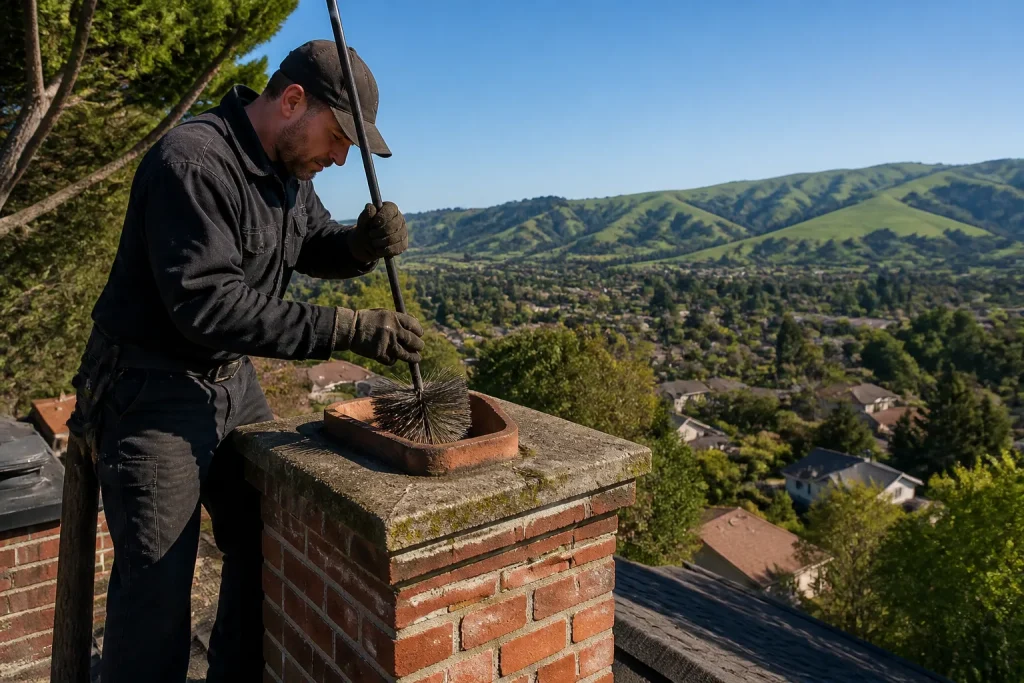
- Sweep method gets more specialized. We use poly brushes or specific stainless brush types designed for metal liners, not the same tooling we’d use on clay tile. Using the wrong brush on a flexible liner can damage it.
- The cap needs more attention. Because a liner is a closed system, the cap is doing all the work of keeping water and debris out. A clogged or corroded cap is a bigger problem on a lined flue than on an open clay tile, because there’s no secondary path for moisture to escape.
What’s the line from Downtown San Jose work that applies here? Built to last, not just cleaned for today. A DuraFlex liner is a multi-decade component. Treat it like one. Annual inspection, proper brush type, and correct cap maintenance keep it doing what it was engineered to do.
Dryer Vents: The Other Flue in Your Almaden Home
Here’s a connection most chimney guides miss. Your fireplace flue and your dryer vent are both exhaust paths. Both carry combustible material out of the house. Both fail slowly and without much drama until something goes wrong.
The NFPA documents dryer vent failure as a leading cause of residential fires, and we see the same pattern in Almaden homes with long interior dryer runs: lint accumulates at the flex points, the airflow drops, the dryer runs hotter, and the cycle repeats until the lint reaches ignition temperature. Sound familiar? It’s the same mechanism as creosote buildup in a chimney, just with different fuel.
This is why Dryer Vent Cleaning in Downtown San Jose is a core service for us, not a side note. Your fireplace and your dryer vent are both fire risks. Both need periodic cleaning. Both should be inspected by someone who understands exhaust systems, not just someone with a brush. If you’re having your chimney done anyway, the dryer vent is a ten-minute addition that could be the most valuable ten minutes of the service call.
Anecdotally: we pulled a dryer vent plug out of a house in the Almaden Meadows area last winter that was the size of a throw pillow. The homeowner said the dryer “took two cycles to dry a towel.” After cleaning, it dried in one cycle. The vent wasn’t just dirty, it was a fire waiting for the right lint density. That’s not a scare story, it’s just what we see.
When to Call a Pro in Almaden
You should call a professional any time you see evidence of flue liner failure, and you should call before you see evidence if your chimney hasn’t been inspected in more than a year. Signs worth watching for: flaking tile pieces in the firebox, visible cracks or gaps between clay tiles at the firebox opening, a smell that you can’t place that gets stronger when the fireplace is used, white staining on the exterior brick near the chimney, or any visible rust or staining on the chimney cap.
More to the point: if a contractor tells you that you need a liner, ask to see the camera footage. If there’s no camera footage, there’s no diagnosis. We don’t recommend a DuraFlex liner or any other repair in Almaden without showing the homeowner exactly what the problem is, on screen, in real time. If you’re not looking at the flue, you’re guessing. And guessing is fine for what to make for dinner, not for whether a chimney is safe to burn in.
Related services in Almaden: If you need a sweep only, a liner evaluation, or a dryer vent check, the same specialist handles all three. No referral to a second company, no gap between the person who inspects and the person who repairs.
The Bottom Line
DuraFlex is a professional-grade flexible liner system that solves a specific set of flue problems: offset runs, damaged clay tile liners, appliance size mismatches, and fuel conversions. It’s not a “better liner” in every situation, it’s the right liner for a particular set of conditions, and knowing those conditions helps you evaluate whether a contractor’s recommendation is based on evidence or just based on markup.
Before you agree to any liner work, demand a camera inspection. Read the quote line by line and make sure the top plate, cap, connection hardware, and insulation are actually on it. Pay attention to the firebox collar connection, because that’s where relines fail. And after the liner is installed, keep the annual inspection rhythm and use a sweep who knows the difference between a clay tile brush and a stainless liner brush.
If you’re in Almaden and want to know whether your chimney actually needs a DuraFlex liner, or if you have questions about a quote another contractor gave you, we’ll look at it with you. Chimney Sweep Almaden offers free estimates and camera-backed inspections. Call (833) 593-6691 and we’ll get a scope up your flue and show you what’s actually there.
Frequently Asked Questions
A complete DuraFlex installation in Almaden typically runs between $2,800 and $5,500 depending on flue length, accessibility, whether the old liner needs removal, and whether insulation is required for a wood-burning application. The range reflects the difference between a straight single-story flue and a multi-story offset flue requiring scaffolding and old clay tile removal. Be wary of quotes under $2,000; they almost always omit the top plate, cap, or connection hardware. Call (833) 593-6691 for a camera inspection and a line-item quote you can actually read.
Yes, when it’s the correctly rated grade and installed with the proper insulation for wood-burning applications. DuraFlex comes in different alloy grades for gas, oil, and wood fuels, and the wood-burning grade is designed for the higher flue gas temperatures and creosote conditions of wood combustion. The key is proper sizing and insulation. We don’t quote insulation as an option for wood burners in Almaden; it’s part of the system. Call (833) 593-6691 and we’ll explain what your specific fireplace needs.
When correctly sized, correctly installed, correctly connected at the firebox, and correctly maintained, a DuraFlex stainless liner should last 20 to 30 years. The liner material itself rarely fails. What fails are the connections, the cap, and the top plate when they’re installed poorly or left uninspected. The annual inspection we recommend catches connection looseness and cap corrosion before they become flue gas leaks. That’s the difference a Chimney Sweep Almaden home inspection actually makes.
In most cases, yes. That’s the primary advantage. The flexible liner is pulled down through the existing flue path from the top of the chimney, even through offset runs that would require masonry demolition to accommodate rigid pipe. The only exceptions are when the existing flue is so obstructed or the smoke chamber so collapsed that we can’t physically pass the liner through. In those cases, partial demolition may be required, but it’s much less common in Almaden than homeowners expect. Call (833) 593-6691 and we’ll tell you what your flue can actually accommodate after we camera it.
Written by the team at Chimney Sweep Almaden, serving Almaden since 2017.
Need Chimney Cleaning Help?
Call Chimney Sweep Almaden - licensed & insured, here with fast help in Almaden.
(833) 593-6691